Let’s Never Settle

Nainativu, Sri Lanka: Snake Island, where golden cobras guard both temple gates

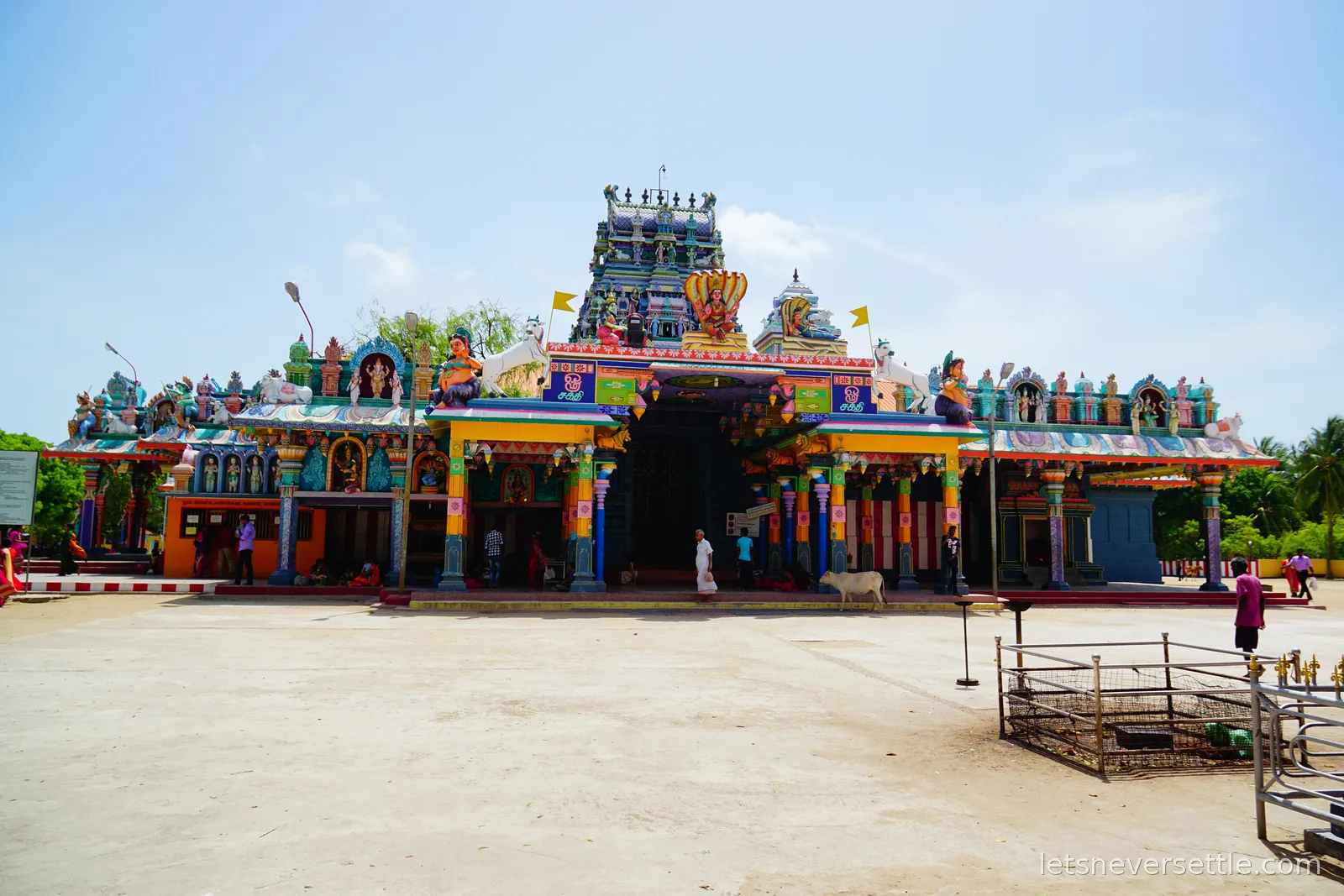
Nainativu, the Snake Island off Jaffna, in July 2018: a boat across turquoise shallows, a cobra-hooded Buddha by the sea, and a kovil the colour of a paint box.

Nainativu is a flat scrap of land in the shallows west of the Jaffna peninsula, and its other name, Nagadeepa, means the island of the nagas: the serpents. Everyone we asked called it Snake Island, so that's what we wrote in the notebook. We spent the middle of 5 July 2018 there, and the snakes turned out to be the ones cast in concrete, gold-painted, and standing guard at the gates.

Getting across

You reach it by boat, and the crossing is the best part of the morning. The water between the islands is so shallow and so clear that it turns a flat, unlikely turquoise, and the far shore sits on the horizon as a thin green line of palms with nothing above it.
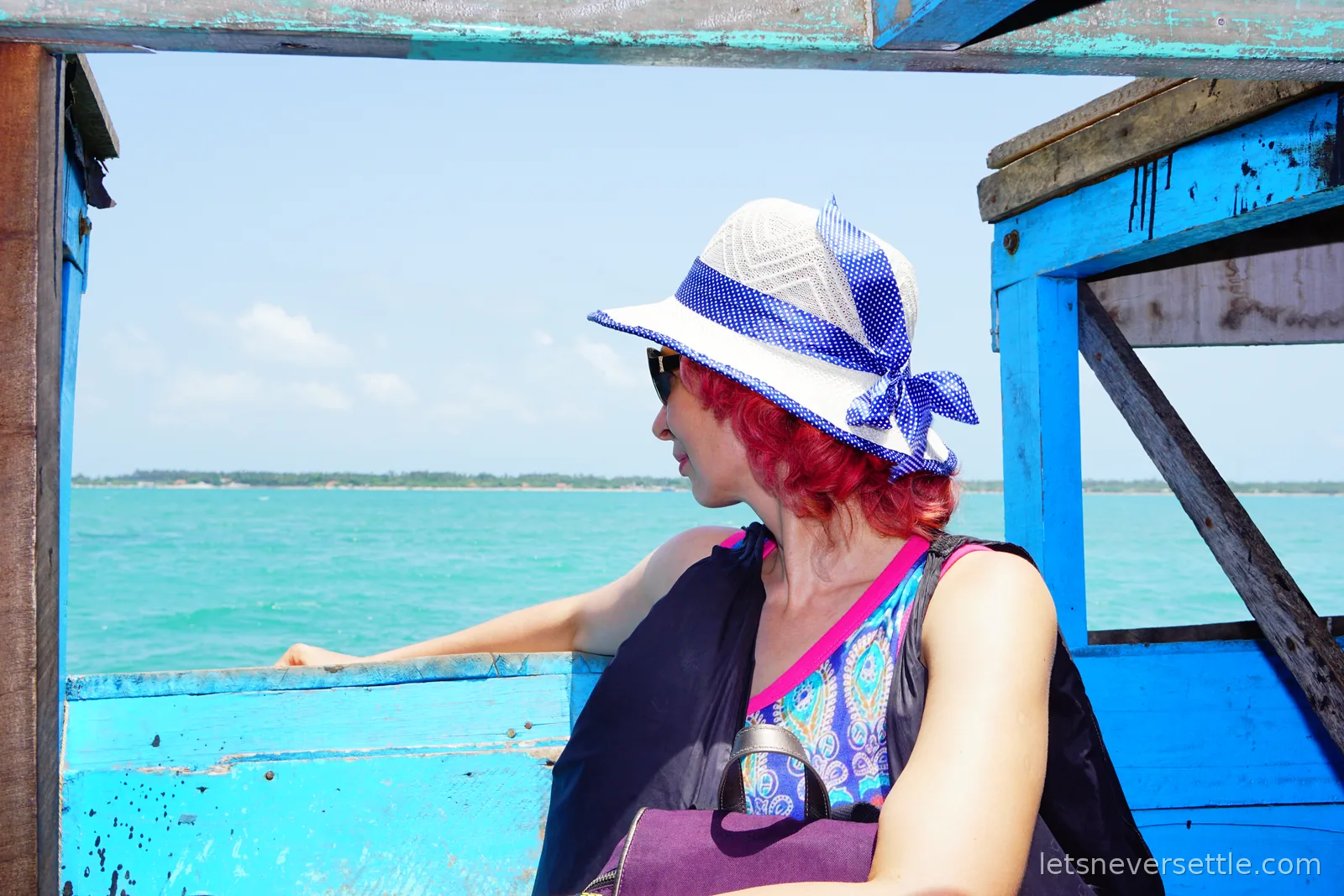
Inga in a white and blue sun hat and sunglasses sitting under the wooden roof of a bright blue open boat, looking out at flat turquoise sea with a low palm-covered shore on the horizon
Blue boat, turquoise water, and a shoreline that's basically just palm trees. Inga picked the seat with the view.

The island itself is small enough to see in an afternoon, and the way to see it is from the back of a tuk-tuk. Ours was red, black and covered in more stickers than paint, including one across the tailgate reading "Keep the distance" and, along the bumper, "Lamborgini Super 3D". The northern-province plate on the back tells you how far north you've come.
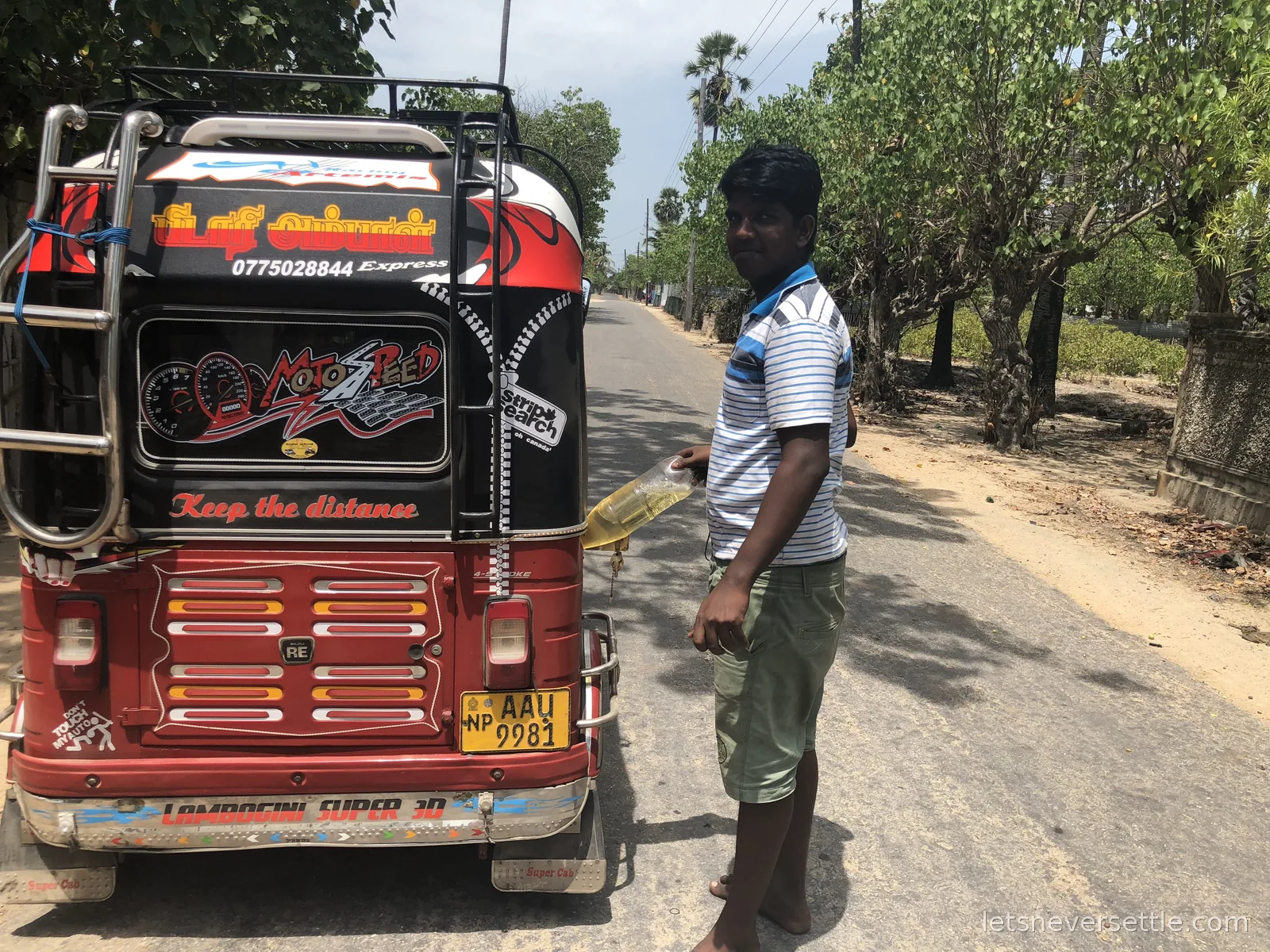
A young man in a striped polo shirt standing barefoot beside a red and black tuk-tuk on a quiet island road, holding a clear plastic bottle of yellow petrol
Refuelling, island style: petrol by the bottle, on a road with nobody else on it.
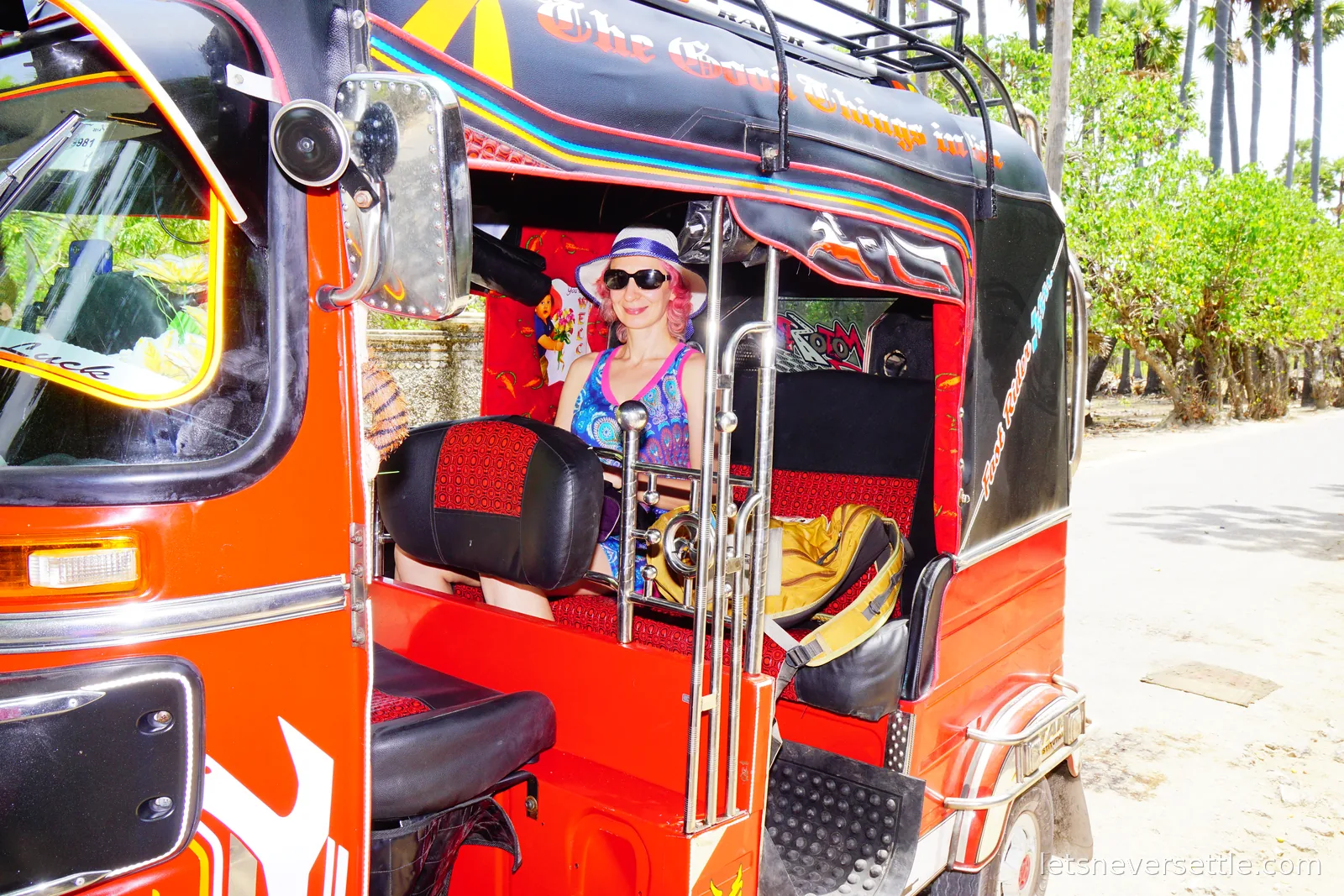
Inga sitting in the back of a red tuk-tuk decorated with airbrushed lettering and chrome bars, parked on a sandy road lined with palmyra palms
The lettering across the roof begins "The Good Things In...", and we never did get close enough to read the end of it.

On the way we put our heads into a small Catholic church, cool and quiet under rough wooden rafters. There's a figure of Christ on a plinth, a carved wooden cabinet lit from inside in green, an altar niche ringed with a neon halo, and a wall clock keeping time over all of it. Three faiths share this little island without much fuss.
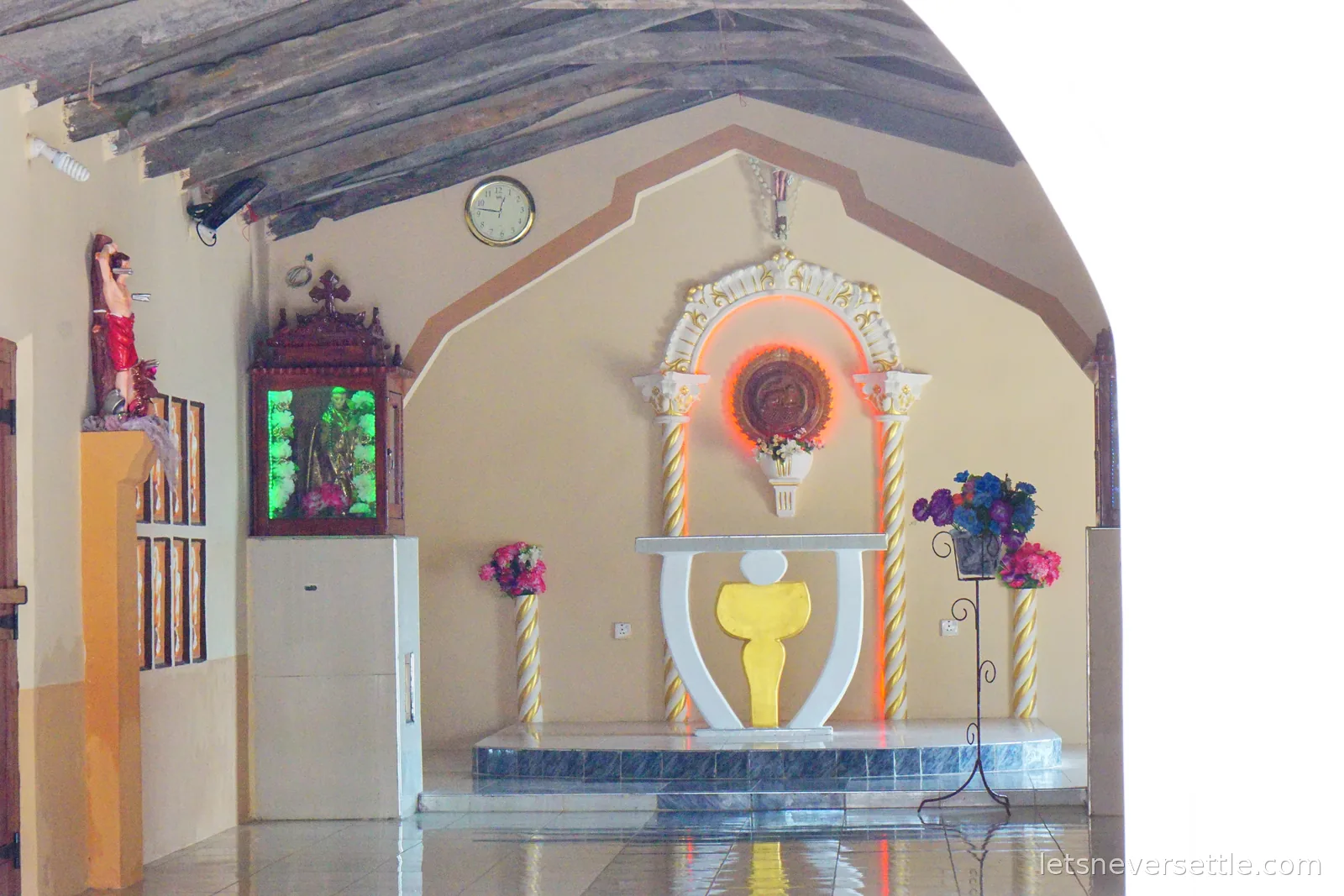
The tiled interior of a small Catholic church with rough wooden roof beams, a figure of Christ on a plinth, a wooden shrine cabinet lit green, and a white altar niche with a glowing red halo
A wall clock, a neon halo and plastic flowers. Village churches everywhere do sincerity better than good taste.

Nagadeepa Purana Viharaya

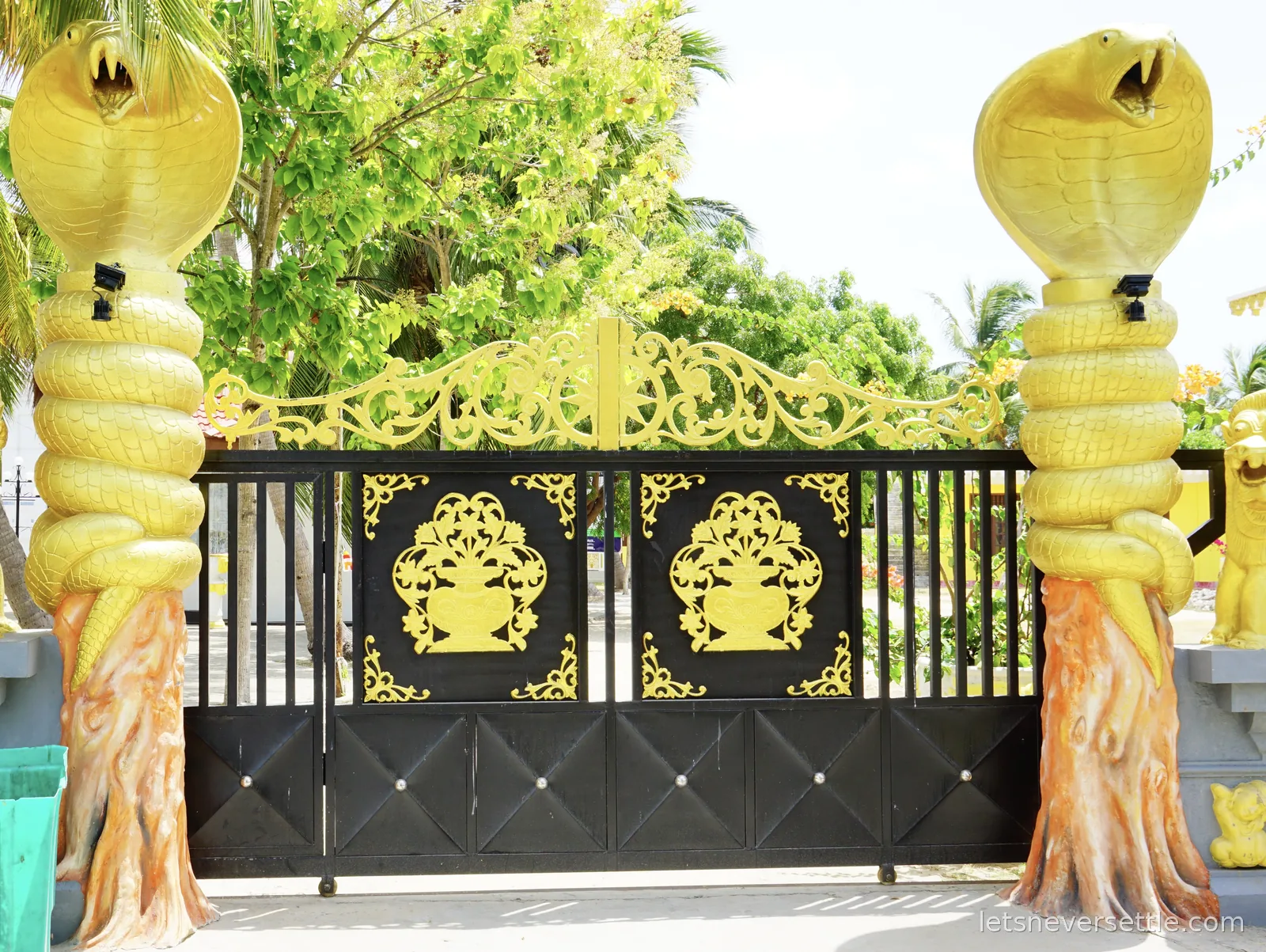
The Buddhist temple is signposted off the main road, 500m, on a green board with a Buddha image on it. You know you've arrived because the gateposts are enormous golden cobras, hoods flared, fangs out, coiled around what look like tree stumps, with a pair of gilded lions sitting behind them for company.
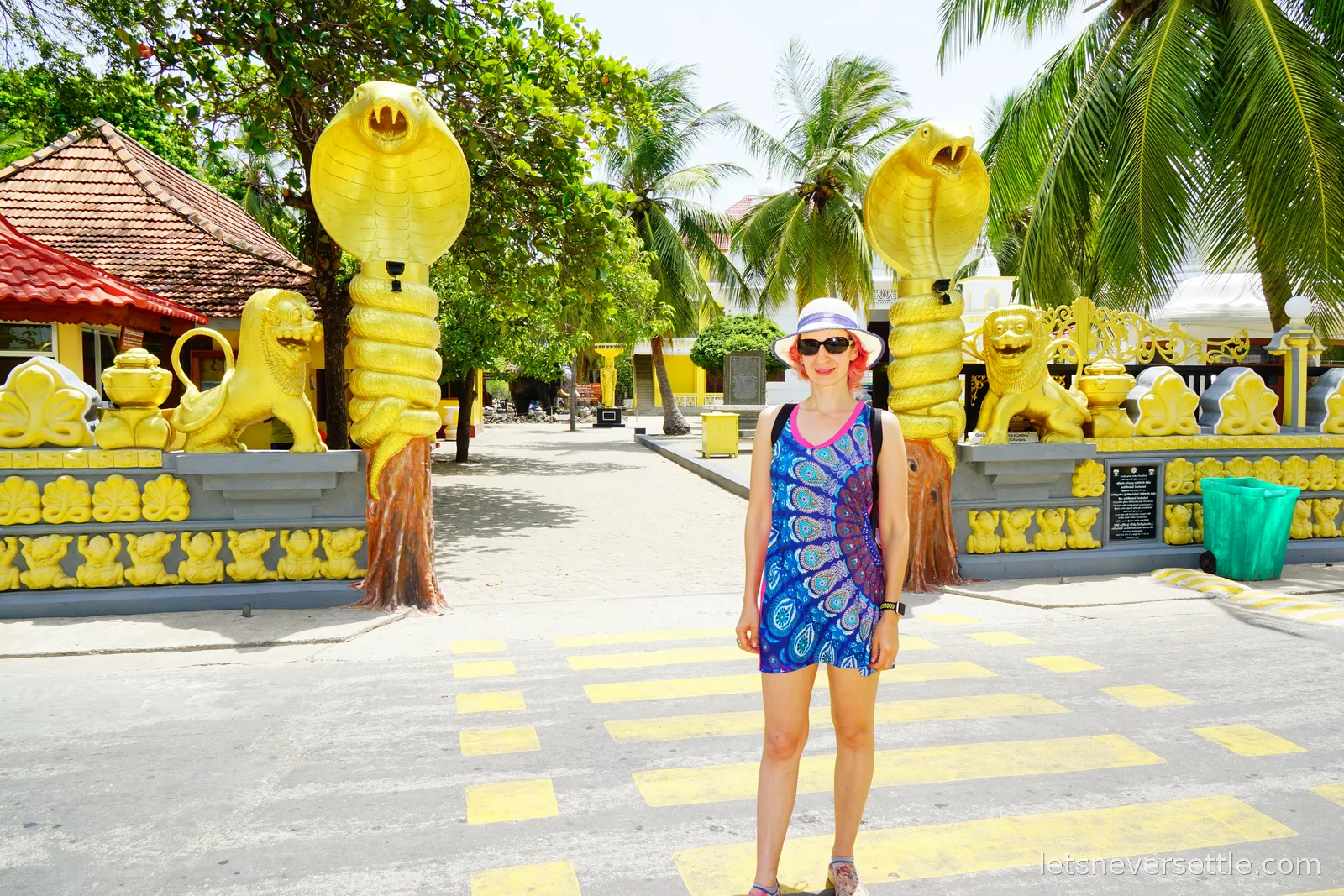
Inga in a blue patterned dress and sun hat standing on the road between two towering golden cobra statues with flared hoods that serve as the gateposts of a Buddhist temple
Two cobras, one Inga. This is the moment the island's name stops being a metaphor.
A close view of the black and gold temple gate flanked by two giant golden cobra statues coiled around painted tree trunks, with gilded scrollwork above the railings
Black iron, gold scrollwork, and the fangs at eye level if you're standing in the wrong place.

Inside the grounds the sea is right there, a few metres past the wall, and the centrepiece is a Buddha seated on a lotus in a red robe with one hand raised, sheltered by a seven-headed cobra that fans out behind him like a canopy. Every head is carved separately, and every mouth is open. The white and gold shrine behind it has "විහාරය" lettered across the front.
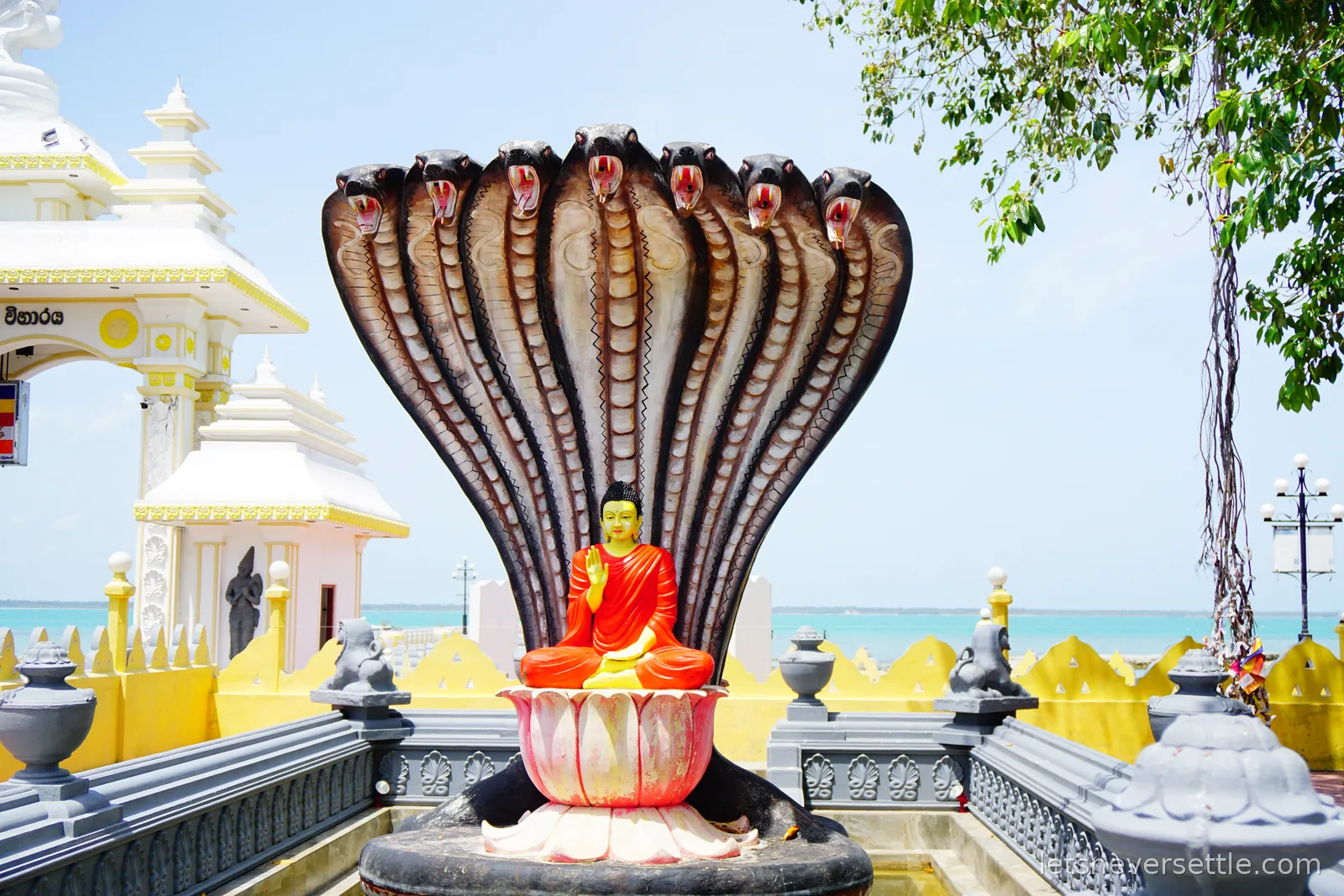
A seated Buddha in a red robe on a pink lotus with one hand raised, sheltered by a huge seven-headed cobra canopy, with white temple buildings on the left and turquoise sea behind
Seven hoods, one raised hand, and the sea a few metres behind. Hard to think of a better place to sit.

Nagapooshani Amman Kovil

A short ride away is the other half of the island's reputation: the Nainativu Sri Nagapooshani Amman Kovil, the Hindu temple that gives Nainativu its pilgrim traffic. The approach runs under a painted archway crowded with figures, and the same green road sign points back the other way to the viharaya, 500 metres.
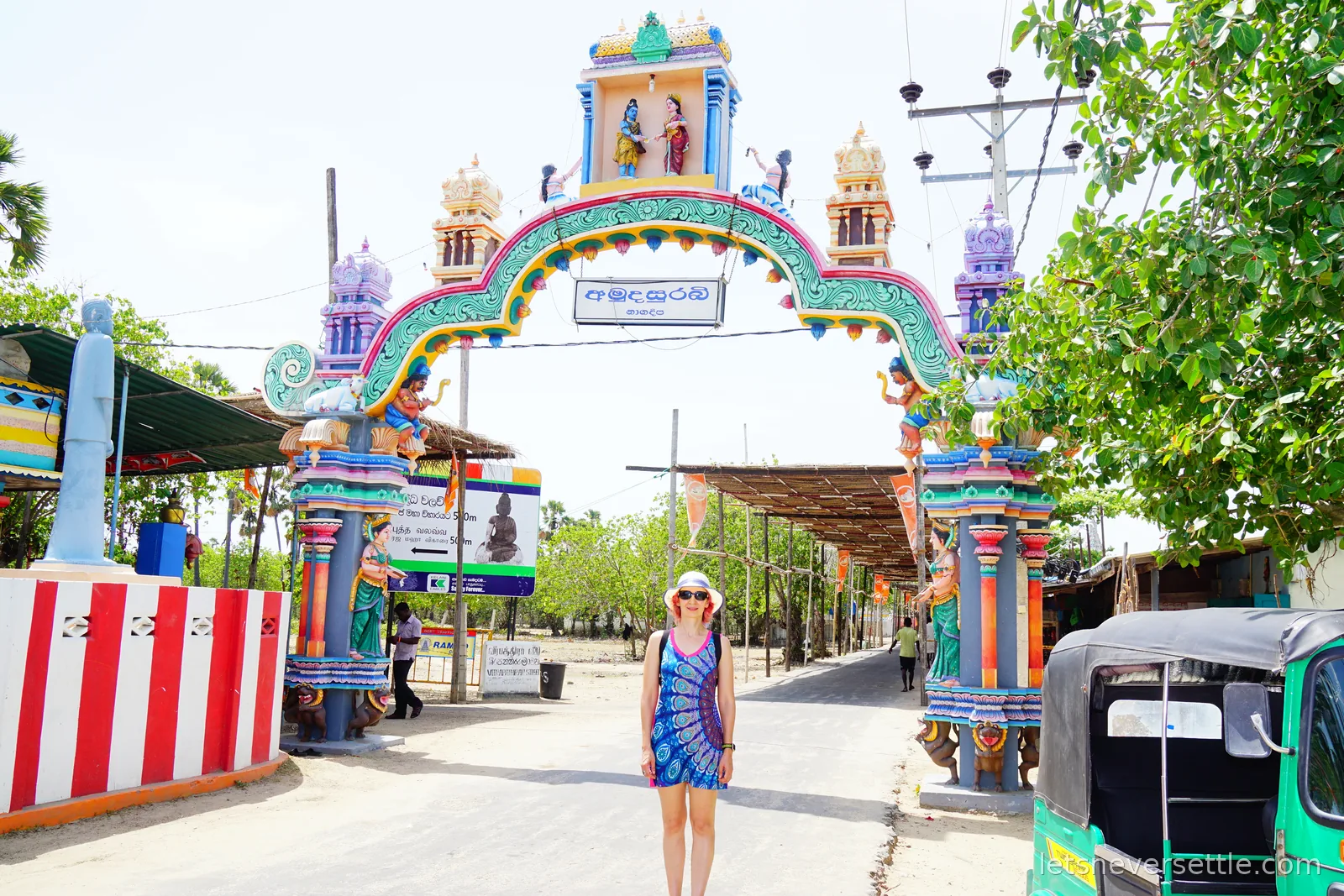
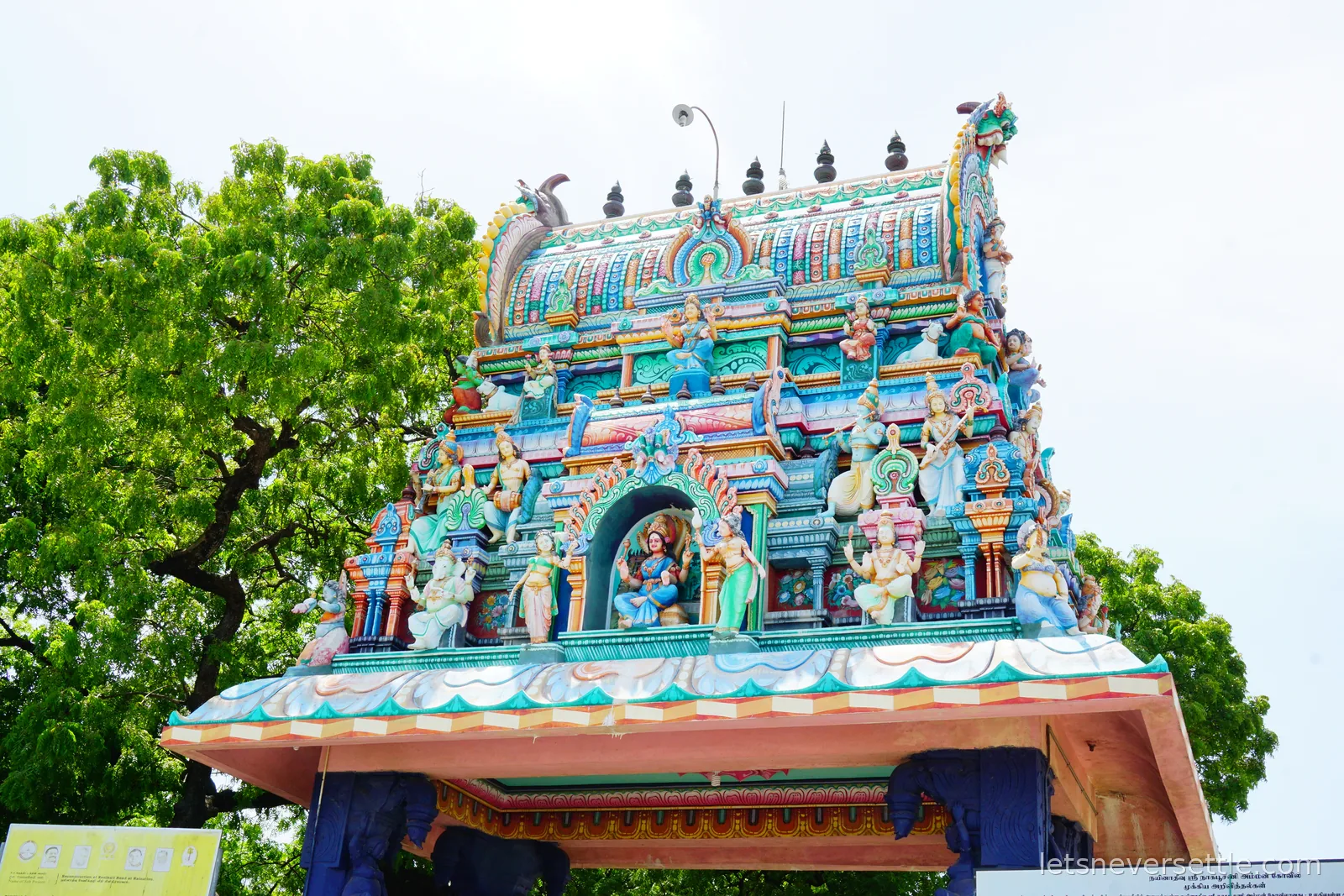
Inga standing on a sandy road beneath a tall painted Hindu archway covered in turquoise, pink and gold figures, with a green road sign and a green tuk-tuk to one side
Under the arch, with a road sign pointing back to the Buddhist temple 500 metres the other way.
A tall temple gopuram tower covered in hundreds of brightly painted sculpted figures in turquoise, pink, gold and green, seen from below against a white sky
The gopuram, seen from directly underneath. There's no colour the sculptors decided against.
The wide painted frontage of Nagapooshani Amman Kovil with its gopuram tower, yellow flags and rows of carved pillars, a cow standing in the middle of the empty sandy forecourt
Early afternoon, and the forecourt belongs to one cow and about four people.

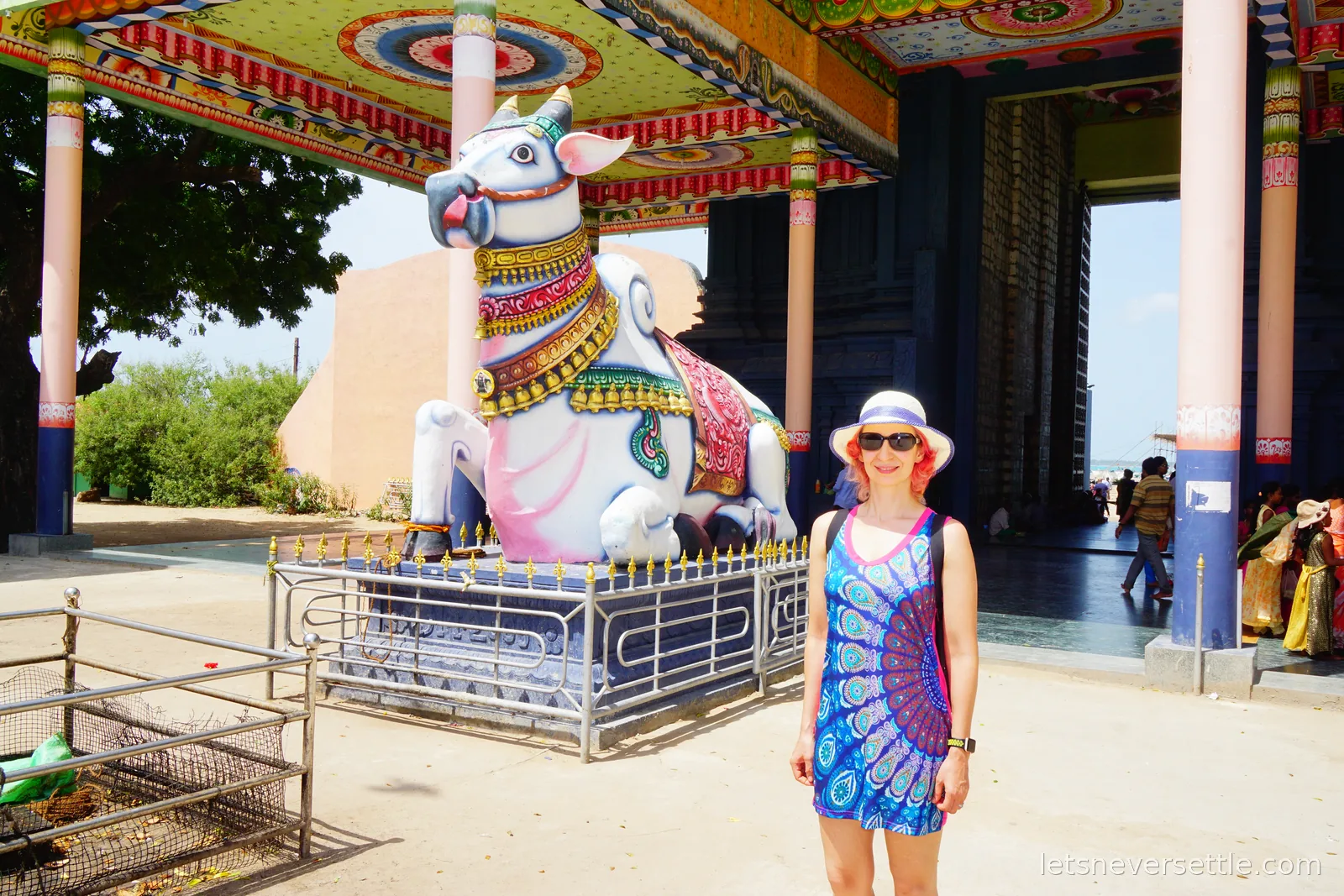
Under a painted canopy at the front sits Nandi, Shiva's bull, white and pink, wearing a saddle cloth, three tiers of bells and a gold collar, fenced off behind a rail of little gold spearheads. Through the doorway behind him you can see the sea again. On an island this narrow, you're never more than a few minutes from it.
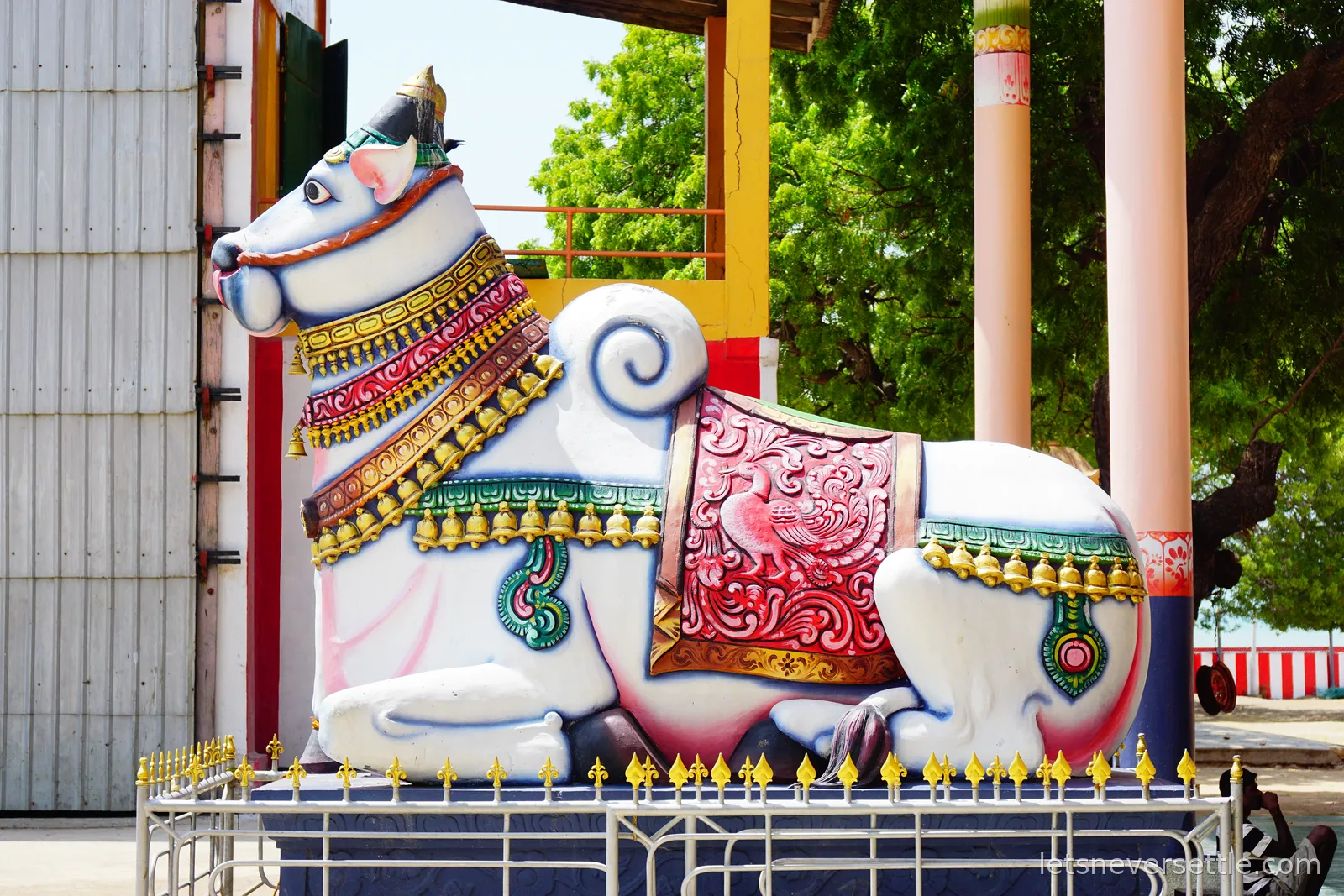
A large white and pink statue of Nandi the bull lying down, wearing a red embroidered saddle cloth, gold bells and a jewelled collar, behind a low fence of gold spear tips
Nandi, with bells, embroidery and a small gold fence to keep admirers at arm's length.
Inga standing in front of the Nandi bull statue under a canopy painted with red, green and gold roundels, with pilgrims sitting in the shade of the temple doorway behind
The ceiling above her is painted with roundels all the way across. Nobody up here does a plain surface.

Nainativu was part of the same July 2018 run around the north as Jaffna, and if you're carrying on down the east coast afterwards, Trincomalee and the reef at Pigeon Island are the next water worth getting into.